27 August 2010
Urban tree survey in UK a great idea for WU
I would love to start implementing these procedures in Salem OR in the area around Willamette University.

31 May 2010
A Bird in the Hand and the Bush


This is the first fledgling crow I have seen in Salem this year and unfortunately it was not doing very well. I ran to the lab to get a George Bush mask so that when I picked it up and the parents spotted 'me' they would not associate my face with the handling of their chick. You can tell it is a hatch year crow because the eyes are cloudy blue and the mouth is pink. When the mouth is closed you can still see a pink gape flap at the base of the bill. The naked patch on the lower abdomen and relatively large legs and feet are also typical. The resting on the wrist joint is also typical at this stage and the youngster in fact can not yet walk. Although this youngster could flap a bit it can not yet fly. This is very common among crows that they fledge before they can really fly and it is important that you leave them alone so the the parents can continue to feed them as they get stronger and develop the leg and wing muscles to truly escape. It can be a week on the ground for these early fledglings and the most successful ones stay hidden under bushes and in thick cover with the occasional contact call to their parents. In the few minutes I photographed this crow and moved it to safety a flock of 9 crows starting mobbing 'George.' This is the first time I have worn a mask during something that the Willamette University crows would treat as an enemy. George Bush had been a neutral mask in our experiments with benevolence over the last year, but now his reputation is made!
If you want to learn more check out

23 November 2009
Pregrine Falcon crossing campus in crepuscular light
It is the Monday before Thanksgiving and the campus is unpacking itself of students and faculty who are heading home early. Feeling a bit left out of the transition to fun and relaxation, I had my spirit lifted to catch the dark and distinct silhouette of a Peregrine Falcon in a long slow glide from over the Capitol Dome across the Star Trees and banking slightly SSW toward the University Apartments. The cross-like form cutting through the crepuscular light of a 430 PM in November was a moment of thanksgiving for me.
22 November 2009
Ground Work for Long Term Bird Survey at Zena
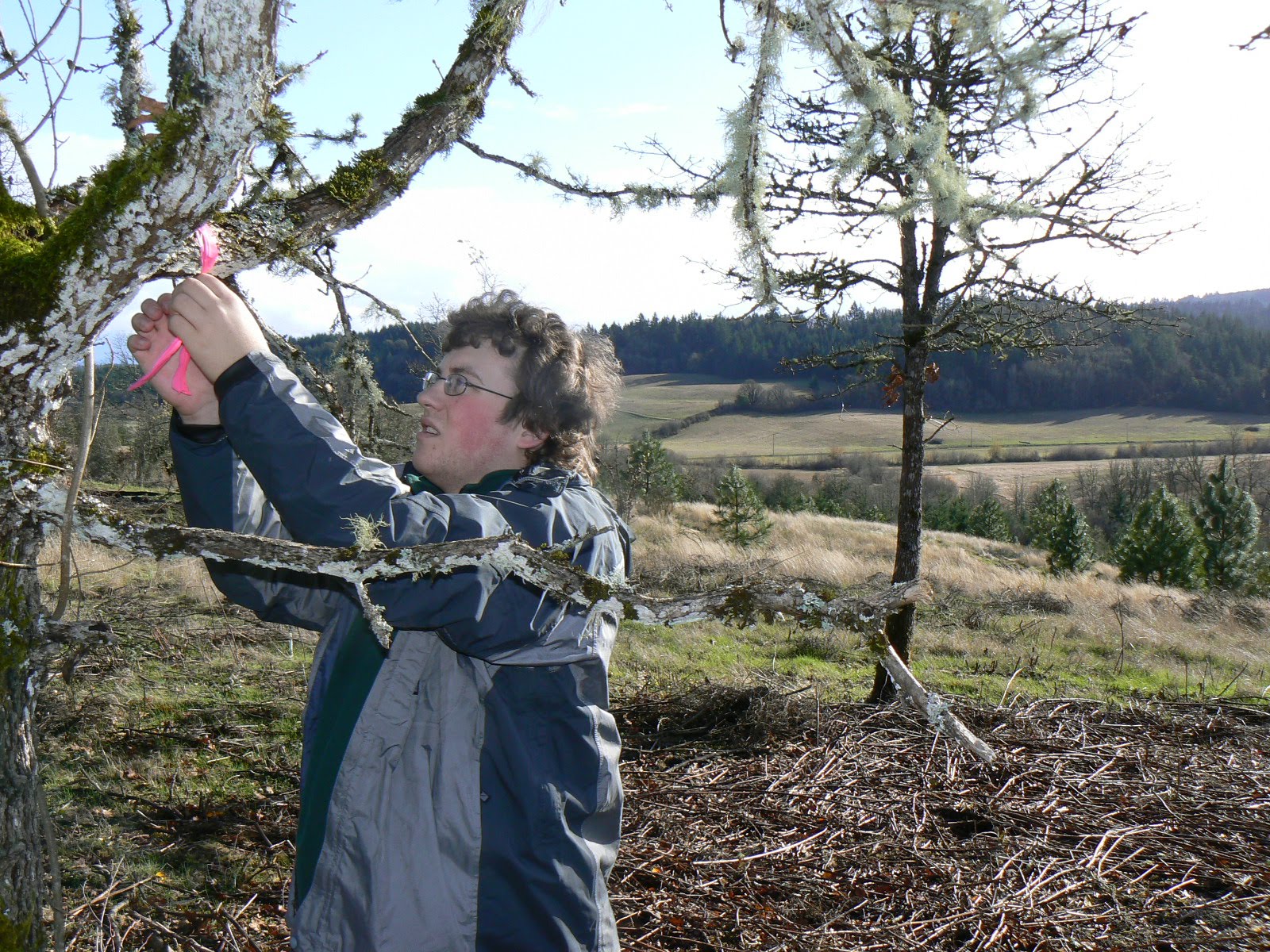


22 November 2009
1030 AM - 1:30 PM
Zena Farms of Willamette University
I spent the late morning and mid-day working with Mary Lugg, Jeffry Kitts, and Ben Gutzler to start laying the ground work for a long-term set of points from which to survey birds at the Zena Farm. Mary was coordinating our efforts today as part of her Behavioral Ecology term project which is also contributing to her senior thesis.
The weather was broken clouds with a few showers that made for lots of mud during our hiking, but otherwise wonderful field time. We spent our survey efforts in the 'House' and 'Savanna Restoration' blocks and were in the constant company of birds including:
American Kestrel - 1
Red-tailed Hawk - 1
Cackling Goose - 22 (high fly over)
Northern Flicker - 1
California Quail - 5
American Crow - 8 (high fly over)
Western Scrub Jay - 9
Black-capped Chickadee - 2
Red-breasted Nuthatch - 1
Bewick's Wren - 3
American Robin - 90
Varied Thrush - 1
European Starling - 180 (high fly over)
Yellow-rumped Warbler - 5
Song Sparrow - 18
Lincoln's Sparrow - 1 (best bird of the day)
Golden-Crowned Sparrow - 13
White-crowned Sparrow - 3
Dark-eyed Junco - 3
Spotted Towhee - 7
House Finch - 2
Pacific Tree Frog (3) and chipmunk sp (1) were also heard during our ground work.
Most of the time was focused on trouble-shooting the use of the hand held GPS units and learning the lay of the land between the points we were trying to lay out. Today's points were 'draft' points until Mary can place them in GIS to allow us to better judge their relative merits. In general I think our points were too close together and we might need to create some sort of a 'buffer' rule so that the survey spot is surrounded with at least 80% of the target habitat type. I was a bit concerned that many of the points were on ecotones instead in core zones, but the landscape and management plans are still new to me.
We marked putative points with pink flagging tape on land marks that had some chance of remaining stable for the next 6 months, but the eventual goal would be to also add some longer-term stakes and durable tags.
The single best bunch of birds was a huge mixed species flock of sparrows and thrushes along the low road between Willamette's property and Anne Cupich's hich included the diminutive mountain breeding sparrow named after Lincoln. It has been a couple of years since I have seen this bird and it made my day. It was the least common bird of the day being an 'occasional' species for this part of the Willamette Valley.
02 December 2008
what is nature...
For several class discussions we talked about the difference between nature and natural. To answer this question we decided to spend a full 24 hours outside, with no food and only a water bottle full of water. The night started off all right, we climbed trees, laid out in Jackson Plaza, and played a few games, finally we decided to go to sleep under the star trees. Later in the night we were disturbed by a stranger who had decided to circle us, we quickly left and wound up spending the night in the basement of Belknap, breaking our 24 hour goal. When we went back outside Sunday morning I really started to notice the difference between nature and natural. We spent the day lounging in our sleeping bags by the Mill Stream watching passersby stare and give us strange looks. I came to find that while the area we were in was natural, there was grass, trees, flowers, plants, it was by no means nature. Nature, to me, is an environment completely free of modern day conveniences. Nature is a place where you can go and not hear the constant roar of traffic, but instead hear the faint trickle of a stream, birds singing, branches creaking in the wind, or the soft rustle of grass. I think that for a habitat to actually be nature there can be no human manipulation, plants and trees grow on their own accord in one giant ecosystem of symbiosis. The Willamette campus has none of these qualities, you will always be able to hear the train no matter where you are on campus, there will always be the temptation of a warm dry building instead of the outdoors, and plants do not grow of their own accord, but instead have been manipulated to grow in gardens that we may or may not find aesthetically pleasing.
01 December 2008
Planet Willamette Nomads


Rose: What is (N)nature? This is a question I have been asking myself ever since our discussion in class a few weeks ago. At first, in attempt to answer this limitless inquiry, me and a few friends were planning on spending a night exclusively in the outdoors, not going to get food, or even going inside to pee. We were attempting to live off the land for a day, in a completely urban environment. After this experiment, I realized that all together it was more of a journey and process of developing my answer than an answer to the question itself. After freezing in my sleeping bag, starving of hunger and nearly getting beaten by a bum, I came to the conclusion that it goes against nature to intentionally slide so far against basic needs. We were attempting to live a completely natural way of life in a completely unnatural setting and this is not nature. Nature is all life forms working together, manipulating and changing to fit one’s own basic needs. Humans have taken this manipulation of the environment into the age of industry and technology and however unnatural, this is still part of natures creation and development.
Eloise: I believe that our campus and the surrounding area can be considered nature, because everything there came from nature at some point. However, while it is nature, I do not think that this way of living is completely natural. A natural way of living would be living completely off the land, and being able to provide for ourselves. As we discovered, it is very difficult to live off the land in the setting of our campus and the city. If we had stayed outside longer than twenty-four hours, we probably would not have been able to find enough of the right food to stay alive. It would also have been near impossible for us to find shelter and warmth without our sleeping bags and clothing. In a more natural setting, we would have an easier time living off the land, however, I still consider our campus to be nature.
Tyler: During my natural (?) immersion experience, I had a lot of time tocontemplate the questions, “what is nature, and what is natural?” It wasinteresting to attempt to carry out an immersion experience in such anunnatural setting. Despite being outdoors, we always knew that we hadcomforts such as food and shelter in case of an emergency, such as thesecurity of a building in the case of a creepy stalker staring at us whilewe sleep, or a meal in Goudy awaiting us after our time was up. Thus,although I believe we stayed in Nature, we were not by any means natural. I accepted the idea that all things derived from Nature are a part of it;however, I drew a distinction between Nature and what is natural. To me,something that is natural is something that would endure without humanmaintenance. We were surrounded by preserved gardens, bright lampposts,and large buildings, all remnants of human influence. To be in a trulynatural setting, we would have to be surrounded by the true, naturalassets of Nature. I also was able to observe how unnatural we humans are. While we were outside curled up in our sleeping bags, various peoplepassed us by. They were always trekking from unnatural building tounnatural building, only braving the outdoors to go be served a mealprepared by intensive human manipulation, or study or go about their dailylives in unnatural, heated, secure buildings. It is evident that humansno longer act naturally. However, the danger of this unnaturalness isthat we will neglect our natural settings, allowing them to be destroyedby our manipulation and apathy.
Emma: I believe that nature is a place free from significant influence by man,like a forest miles and miles away from civilization. While what we havearound campus, like the trees and grassy areas, is natural, it is notnature. Nature has true ecosystems and is not tended or cared for byhumans. So, during our staying outside experiment, the outside settingalmost worked against us. Because we were in man-made nature there wasnothing to forage and no where to burrow, where as in true nature boththose things would be somewhat easier.

18 November 2008
17 November 2008: Spiderweb
Rose Dickson
17 November 2008
2100 – 2120 hours
On the main stage of Kresge Theatre on Willamette University campus, Salem, OR, USA
42 degrees, clear
All this week I have been staying up late having dance rehearsal in preparation for the dance recital coming up this weekend. We are working in the Kresge Theatre and the booming lights create indescribable heat that is almost unbearable. As I was waiting for my piece to begin I looked up onto the ceiling and noticed right next to one of the radiant lights was a spider on a spiders web. If I can barely stand the heat from this distance, how can a being so much smaller and more fragile than I handle that kind of heat? Is the spider even alive? How long has it been living up there, watching all the shows go in and out of production stage? The web looks new and perfectly in tact, not at all like an ancient cobweb so I assume the spider is alive and well. I wonder how it gets its food? Are there really that many bugs available in this kind of space? Will the spider die soon due to lack of food? I wonder if by performance time he will still be there, as an extra audience member!
17 November 2008
15 November 2008
all day
around the Willamette university campus
It has been sunny for the past two days. It is unexpected and weird. I no longer know hat to do with myself. This is Oregon, I have already dealt with the fact that the sun does no live here. I cannot reprocess something like this!! But I do love it, I can wear dresses for a few days and it is not trompy mud for a few days. Unfortunately humans cannot photosynthesize, that would be really nice and probably solve world hunger.
Tyler Starr: 11/16, UPS Arboretum

Tyler Starr
16 November 2008 from 1340-1355
Location: The Arboretum of the University of Puget Sound
Weather: 53 ̊ F, slightly hazy, partly cloudy skies, no wind
(Sorry it's posted after sunset. I had it typed up before sunset but I didn't have Internet all day because I was traveling)

9 November 2008
1600-1615
On the grass between the mill stream and the University Center.
Luckily these are our classes’ last nature observations. The mill stream looks the same as it always dose. Where there is water in it at least. To be honest it was not really that interesting after the first made second post. So there are rocks and the ducks that have not gone south yet. It is interesting, that these ducks are not in Mexico or something like that yet. Perhaps the just don’t want to or are helping along natural selection, I really don’t know. Anyway as usual there are a few people also on the bank of the mil stream with me. And all the trees around the mill stream are now completely leafless. It is quite sad and skeletal looking but there will be leaves in the spring so no real issues here.

November 11, 2008
1100-1200
All around the Willamette university campus.
The nicest part of my outdoor experience this week was yesterday night I tromped around in my rain boots for more time than most other people my age. It was absolutely fabulous. The ground was incredibly wet and sloppy from the two days or rain we just got. There was also and abundance of large puddles especially in the sparks parking lot. It was really nice to be around in that time of night just appreciating the aftermath of rain. Usually I do not wear rain boots, therefore the mud and puddle are usually just an obnoxious burden. But last evening it became a time of glorious mud trudging.

13 November 2008
1130-1145
Lawn by the chicken fountain.
On the way to my French class today I got very distracted and ended up being about fifteen minutes late. Anyway the reason I became distracted in the first place was there were all these fallen leaves in the grass. First I notice one that had five arms of all different lengths. But what was most interesting was how this particular leaf did not completely change from green to red. Instead it got caught up in the transition and ended up somewhere in the middle with some of it still solidly green while other parts were glowing ember colored. The other nice leaf I found was of the same shape so perhaps the same tree, but this one had three red prong arms, while the other two were still yellow. What made this leaf super interesting was its abrupt change from red to yellow, it was like there was a curvy line defining the two part of the leaf. My final find was a smaller had three arms but had many jagged fingers coming off. It was pure red but I you look closer there was a darker red border all around it.
16 November 2008
Foggy day

H.Waller
Date: 16 November 2008
Time: 1130
Location: All of Salem, OR
Weather: FOGGY, 52 degrees
Today I awoke to a sky that was entirely white. Upon further inspection I noticed that it was not only the sky that was this color, but everything was cloaked in a sheet of translucent white. In Montana, this would mean that it was snowing and likely blizzarding or close to it, so I bundled myself up in layer upon layer, including a scarf and mittens before heading off to brunch in the late morning. However, when we stepped outside I realized that though it looked freezing compared to the last two sunny days we have had, it was really about the same temperature, and I was way overdressed. The fog stayed all day long, and now at 2036 it is still just as foggy. Walking back from sectional an hour ago was creepy because all you can see of the people ahead is their silouette and it's even hard to tell if they are coming or going. I also think the fogginess makes people move slower. I wonder if it has any effect on other animal life?
Photo courtesy of Google Images
Moss

H.Waller
Date: 15 November 2008
Time: 1700
Location: In front of the TIUA entrance in the parking lot
Weather: Cool, sunny, 50 degrees
As I was walking back from working on a project in Gatke I decided to mix things up and run across the street rather than take the sky bridge home like usual. It was strange going a different way that I normally do from the building, and everything looked different from this new angle. When I got to the parking lot in front of TIUA I noticed on the concrete several patches of bright green moss growing up through the blacktop next to where the sidewalk creates a ledge. How peculiar it is for there to be life growing up out of such a man made and synthetic surrounding. There are plenty of trees nearby that it could be on instead, but it is here. I can't imagine how it gets its nutrients from this location, or how it got there in the first place.
Photo courtesy of Google Images
10/15/08
Location:Mill Stream
Date: 10/15/08
Time: 1600 hours
Weather: Cold and foggy
The mill stream is really quite dirty. I'd expected that with the increase in running water it would wash some of the dirt that accumulated during the shallow "season" to get picked up and carried downstream. I thought that it would have at least settled to the bottom anyways. However, I was wrong. The water is brown and murky and you can barely see the bottom. But the ducks were back earlier this week and that's always a good thing in my opinion. They did increase the water flow which is what I assume made them come on back but I can't be certain. Maybe they were just stopping by before their long journey. I want the mill stream to be back to what it was when I first got here and how pretty it used to be.
H.Waller
Date: 14 November 2008
Time: 1600
Location: bush park
Weather: chilly, but sunny, 52 degrees
I forgot how much I love to run. Today a friend asked me if I wanted to go running around Bush park, and though I was somewhat reluctant at first, I agreed to go and ended up loving it. There is something about getting a good workout while being immersed in nature itself that gives me a sense of satisfaction I haven't found elsewhere. We ran about a 5 mile loop and during much of the run my feet were crunching upon trails covered fully in leaves of red, orange and yellow. Up higher into the park is where all the humungous leaves are that are now dried up and more shades of dark green and brown and have curled up their edges forming bowls to hold the rain that has fallen here recently. I also spotted a squirrel that struck me as unique because he was the same size and color as all the other tons of squirrels around, except that this little guy had right red-orange coloring on the end of his tail and the top of his head.
10/14/08
Location: Capitol Grounds
Date: 10/14/08
Time: 1300 hours
Weather: Sunny and brisk
On our way to view the protest going on at the capitol building and then to the speech thereafter, Dave spotted a sight that I was waiting to see. A peregrine falcon had perched itself upon the top of the building itself and was scoping out the terratory around it. From where I was the bird still looked magnificient. All I could see was its back but I could easily see its shape and deep gray feathers against the contour of the white walls of the building. I wanted to see it in action so badly but alas, it merely sat there, almost pondering the reason as to why so many had gathered. Maybe even annoyed that so many would scare off the food. Or perhaps delighted that more people would entice more food to arrive.
Chestnuts!

Time: 1807-1825
Date: 15 November 2008
Climate: Not too cold out, brisk and refreshing
Location: Walking around campus and towards Salem City Center
As I walk around campus and towards the Salem City Center with friends we are walking under a good amount of Chestnut Trees. The chestnuts are falling off of them still and this is shocking to me. They seem to have been falling for forever now. One dropped right behind me and came so close that I could feel the vibration on the sidewalk in my shoes when it hit the ground. It is slightly unnerving to walk under them because I always fear that they are going to fall on me. There are so many chestnut trees around and so many chestnuts on the ground. I definitely thought that they would not be falling as much anymore but lately I’ve been noticing it more that ever. Maybe it is just me finally realizing it but I do think more have been falling that were before.
http://www.kitchengardeners.org/pics/chestnut12.19.05.JPG
ducks
Time: 1135-1155
Date: 14 November 2008
Climate: Sunny, cool air, a bit breezy
Location: Mill Stream next to the Botanical Garden
So I love sitting at this one spot by the Mill Stream. It is on a tree stump with a little bridge to my left and the Botanical Garden behind me. Once again I am facing Matthews Hall and Belknap. The water is up to its normal level again and I see ducks! I rarely see ducks here especially when there is a normal amount of water. The water flows a bit faster here, and it is a bit noisier as a result. I don’t usually see ducks here and I thought it was because there us faster louder water but today was different. They were just relaxing and hanging out on the side of the stream. They didn’t move much or make much noise. After about 10 minutes they left their little area and flowed down the rover with the water. They had been in the same spot for what seemed like a long time but then they left like it was nothing. It was like they just let go of where they had been staying and just moved with the water.
Star Trees

Time: 2308-2335
Date: 13 November 2008
Climate: Very Chilly, Overcast, windy
Location: Star trees, Willamette University campus
I decided to take another late night walk around campus. I wandered all over past the library, across the quad, through the Japanese garden and some other places ultimately ending up under the star trees. I sat down and the ground was damp and soft. I looked up and saw the star made by the trees but what caught my eye first was the sky. The clouds were moving so fast that I couldn’t keep my eye on a single part of the sky. The moon is showing through the tree closest to cone chapel, which is diagonally to the left of me. The star trees are really nice to sit under because there is nobody around me right now and I am alone but I feel safe. Something about these trees allow me feel comfortable because they are so big and relaxing. It is something that I can’t really explain, but for some odd reason they are captivating. I get up and realize that my pants are all wet from the ground and have thin pine type sticks stuck to them and dead leaves. I pick them off and I look up again. They sky looks completely different from when I first got here. I spin around and closed my eyes and I had no idea what direction I was facing when I opened my eyes. It was such a strange feeling because the star trees look so much alike at the tops. I began to walk back to my dorm and the grass was much sloppier than the ground under the star trees. This was surprising to me because the star trees are shaded so I would expect the ground to be wetter but it was not. As I walked back to my dorm I walked through the Japanese Garden again and down Winter St. There were no students out and barely any cars on the road. For some reason campus was particularly dead tonight, and seemed almost empty. The trees are beginning to become bare and the sidewalks and roads were empty. But it didn’t feel that way under the star trees.
http://www.2librarians.com/family/willamette/StarTrees.jpg
Subscribe to:
Posts (Atom)